


The customer's Tuesday
It's 6:40 on a Tuesday. Somebody in Georgetown just moved in and needs a dentist. Somebody in Winchester heard your name at the counter and is looking you up in the parking lot. Somebody in Richmond wants dinner and is standing on Main Street. None of them are at a desk. They're on a phone, on a cell signal, and they'll give the first result about five seconds. A website has one job: turn that stranger into a phone call. Everything else, the animation, the clever headline, the color scheme, is in service of that or it's decoration.

What web design covers
- Fast on a phone. Most people find you on a cell signal in a parking lot, not office wifi. If your site takes more than about three seconds, a good chunk of them are gone before they ever saw your name.
- The answer above the fold. What you do, what town you're in, and how to reach you — visible without scrolling. If somebody has to hunt for what your business actually is, you've lost half of them.
- One tap to call. Your phone number should be a button. On a phone, a number somebody has to copy down by hand is a number some of them just won't dial.
- Real photos, never stock. Your actual work, your actual building, your actual truck. People here spot a stock photo instantly — and when they do, everything else on the page gets less believable.
- Built by hand. I write the code. That's why these load fast and don't break when some plugin updates itself at 2am.
- You own all of it. Your domain is registered in your name and the site is yours. You can walk away with it any day you like. I've never held anybody's website hostage and I'm not going to start.
How it works, step by step
The Blueprint Session, free, thirty minutes
I sit down with you at your counter, your kitchen table or on the phone, and look at what you have: the current site if there is one, the Google listing, and who's showing up ahead of you when a customer searches your trade and your town. I ask one question first: what does your business do that nobody else in town does? That one thing is what the site gets built around. If the honest answer is that you don't need a new site yet, I say so and you keep your money.
Scope and a number, in writing
You get a one-page scope that says exactly what the site will have and what it will cost, from the published price card, before anything starts. A single page, five pages, or ten. Half is due to start and half when you've seen the live site and approved it. There is no surprise on the invoice because the number was on the website before you called.
Photos and words, from you and from me
This is the honest bottleneck on every build, so it starts day one. Your real photos: the building, the room, the plates, the crew, the finished work. Your prices and hours. Your services in the words a customer says out loud. I write the pages in your voice, and I'd usually rather do a half-day photo shoot than use a stock image, because people here can tell.
The build, by hand
I write the code. No page builder, no theme, no plugin that updates itself at 2am and takes the contact form down. That's why the sites load fast on a phone and why they don't break. While I build, you see it on a private preview link on your own phone, and you and I go through it together before anyone else does.
Tested in a parking lot
Before a site goes live I load it on a phone, on a cell signal, in a parking lot, and time it. Then I check the four things every site I ship must do: about three seconds to load, what you do and where you are on the first screen, the phone number a button, and real photos. It's a written checklist and the site doesn't ship until it passes.
Launch, and then care
Your domain in your name, the site on fast hosting, submitted to Google with the right structured data so it's found. Then the care plan, $100 a month, keeps it current: you text me the new hours or the new photo and it's handled within 24 hours—often same-day. You never learn a dashboard.

Who this is for
Not one kind of business. I work with restaurants, shops, clinics, offices, venues, farms, churches and the trades, and the work bends to each one:
- A restaurant — hours and a menu that load on a phone at 7pm on a Friday, a map that points at your building.
- A boutique or a shop — real photos of the room and the stock, the hours, a way to message you, and the story of why you opened.
- A dentist, a clinic, a salon — what you do, who you see, how to book, and the reassurance a nervous new patient is looking for.
- A law office or an accountant — credentials, plain-English service pages, and a phone number a stressed person can tap.
- A venue, an inn, a farm — photographs that do the selling and an inquiry path that works at 11pm.
- A church or a nonprofit — service times, how to give, how to help, and a site somebody can update.
- A contractor or a trade — a page per service, the towns you roll to, your trucks and your finished work.
The numbers, plainly
| $850 | Real starting price — published on the pricing page, not quoted after a call |
|---|---|
| 1–6 wks | The honest build time, depending on size |
| 100% | Yours — domain and site registered in your name |
What it costs
- A single-page site is $850 and takes one to two weeks.
- A five-page local business site, home, about, services, service area and contact, with multi-keyword SEO, Search Console set up and the right structured data, is $2,600 and takes two to four weeks.
- Up to ten pages with a blog and town pages is $4,500.
- Stores and booking integrations start at $6,500 and get quoted after you and I have talked about what the site actually has to do.
Every build carries the $100-a-month care plan. Half to start, half at launch after you've seen the live site. All of it is on the pricing page, and it was there before you called.
Say you run a boutique on Main Street
You've got a Facebook page that does most of the work, a website from 2016 with a slideshow, and hours that changed last spring. Here's what the $850 single-page build looks like for you. The first screen says what the shop is, the street it's on, today's hours and a phone number that dials; that's the answer a visitor on the sidewalk wants before she scrolls. Below that, six real photographs of the room and the stock, taken on a half-day shoot or on your phone with a little coaching, because a boutique's website is its window. Then the story, four sentences in your voice about why you opened, which is the reason people buy from you instead of a chain. Then a map that points at your door and a line about parking, because downtown parking is the question everybody asks. And a button to message you, since a boutique customer texts more than she calls. The Google listing gets matched to the site the same week, and the care plan means the new arrivals and the holiday hours go live the evening you text me. One page. About two weeks. The whole first year, everything included, prints on the pricing page at about $2,146.
What a website won't do
It won't fix a bad Google listing, and for a lot of local businesses the listing matters more than the site. It won't bring customers by itself in the first month; ranking takes three to six months and the site is one input. And it won't make a business with wrong hours and unanswered reviews look trustworthy. I'll tell you which of those you actually need before I sell you a site.
Web design across Kentucky, from Winchester
I build for Central Kentucky first, in person:
But the rules don't change at the county line. A site for a Kentucky business has to load in about three seconds on a cell signal, because a lot of this state is one bar and a long driveway. It has to say the town, because "serving the region" doesn't rank and doesn't reassure anybody. And the photos have to be yours, because people here can spot a stock photo from across the room. A single-page site is $850, five pages is $2,600, and every price is on the pricing page. If you're a contractor, a roofer or a restaurant, I've written a page about what your site specifically needs: contractors, roofers, restaurants. Every build carries the care plan, so the site stays current without you learning a dashboard.
Winchester and Clark County businesses: there's a page on web design in Winchester, Kentucky, with the four rules, the prices, and a site down the road you can go look at on your phone.
Go look at the live sites on your phone.
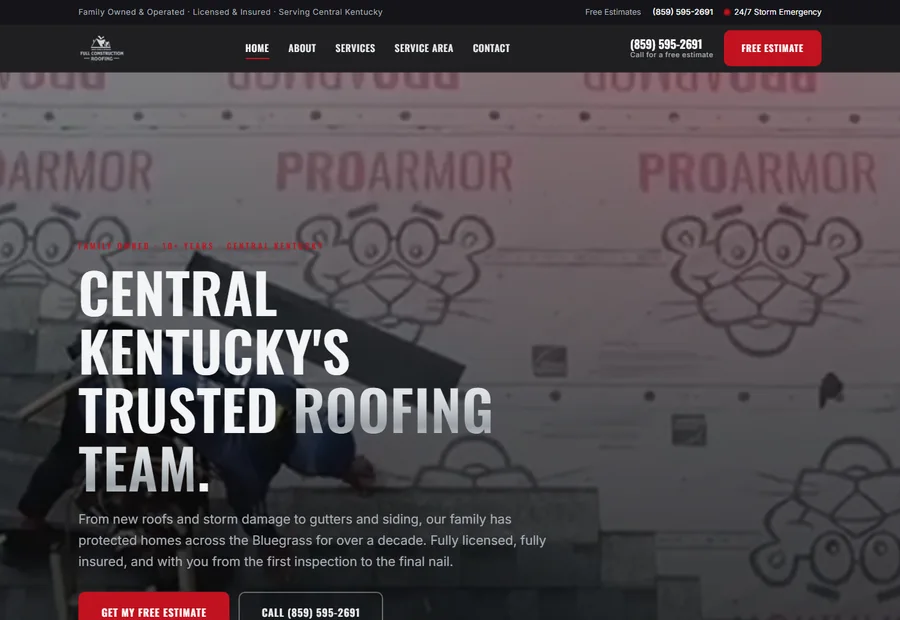
I don't show mockups as proof. The work page links to real businesses with real sites I built, live right now: a roofing company in Winchester and a Kentucky woodworker's shop with a working online store. Load one on your phone, on a cell signal, and time it. Tap the phone number. Look for a stock photo. That's the whole pitch, and you can check it before you ever call me.
Where I work: Winchester, Lexington, Richmond, Georgetown, Mt. Sterling, Nicholasville, Paris, Versailles.